The F50 never broke Ferrari tradition, it just revolutionized it

Had you read one of my earlier articles about Ferrari’s shady operations (entitled: The Unmasked Criminals), you probably would have gathered the impression I’m far from the world’s biggest Ferrari fan.
However, I mustn’t kid myself; this iconic firm has produced some of the world’s most fabulous vehicles. From the amazing ‘F40’ to the multi-million dollar ‘250 GTO’, they create many vehicles, which quite simply, are things dreams are made of.
While I’ll greatly admire those models, I feel there is one particular vehicle assembled in Modena that is indeed up with there with the best, but happens to be one of the most overlooked vehicles to ever wheel out of the legendary gates in Modena.
That vehicle happens to be their 50th anniversary supercar which they refer to as the ‘F50’.
Ferrari’s last major supercar previously, the ‘F40’ had been a great success for Ferrari. Released in 1988 with an original planned production of just 400 units, Ferrari was able to successfully produce and sell exactly 1,315 units. By the time Ferrari’s 50th birthday arrived, the idea for yet another ground-breaking flagship had arisen. The concept of the vehicle had been not to further improve on the predecessor as the F40 had done with its own predecessor, the 288 GTO, but to assemble something entirely new. Something that would most properly abide to what Ferrari was aiming at creating, ‘a racecar for the road’.
Problem is, while magazine publications constantly brown-nose Ferrari’s recent crop of vehicles, the foundation on which these vehicles were created on is being forgotten. Mind you, it’s not only the media that deserves a slap in the face, its automotive enthusiast’s world wide - if I may be frank. While general interest in Ferrari supercars is focused on that of the ‘Enzo’ and the ‘F40’ (and to a lesser extent the ‘288 GTO’); the F50 is a vehicle which is constantly ignored but most certainly shouldn’t be.
I suppose the important question here is, why?
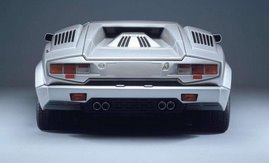
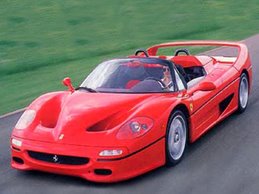
Well, the fact that the F50 wore a carbon-fibre body shell that was often criticised as being unambiguously ugly certainly didn’t help it garnish a sterling reputation. Unlike previous attempts which had slowly evolved the hard-edged square-ish designs of the 1980’s, the F50 revolutionized Ferrari design. Ultimately, I think that they tried to blend the old familiar traits which fanatics associated the brand with (like the F50’s rear-end resemblance with the F40), but also tried adding a new degree of allure by making something ‘out of box’. As a result, the F50 could be described as anything but a blocky square; the F50 was a body of curves and shapes, and this alone didn’t sit well with hardcore Ferrari fanatics.
So then, how do I personally feel about the F50’s styling? Well, I think it’s absolutely awful; from front to back I think it’s vulgar in every way imaginable. This is an opinion shared by many other automotives enthusiasts and if styling is your major concern (as I imagine it is for most others) then the F50 is not going to fulfill your needs regarding beauty as it has more or less the same attractive qualities ascribed to catching a venereal disease.

One could argue though, that the preceding F40 was far from the prettiest car on the block. I’d certainly agree that it doesn’t have the beauty of something like an Aston Martin, but in some special way, it’s got a handsomeness which is certainly more attractive than the F50. Think of a Teutonic knight if you will; no delicate features, but brutally attractive and most certainly awesome. Whereas the F50 is all tortured lines to me.
Mind you, Ferrari’s goal with the F50 was never to make a beautiful car, but rather to further push the envelope of aerodynamics. Whilst the F50’s body had a higher drag coefficient than that of the F40 (.34 CD versus .36 CD respectively), the undertray had been sculpted in order to more or less make up for the higher CD. Even the god-awful nostrils gracing the front of the car are functional – equipped with a series of fans they help to create downforce through the front of the vehicle thus increasing its cornering abilities and general performance figures.
I don’t doubt that for one second that biggest downfall of the mid 90’s supercar was its exterior metal; something which is very unfortunate considering it cloaked what turned out to be such a brilliant car.
Sadly, the F50 fell to further criticism when it came to its engine and more importantly, it’s straight line performance. Whereas previous Ferrari flagships such as the 288 GTO and the F40 maximized power from 8-cylinder engines with forced induction, Ferrari had an all-new trick up their sleeve for the engine of the F50. That trick was to borrow the basic engine plan from their 1993 333 SP LeMans car. In standard guise this engine had: 5 valves per cylinder; 650bhp; a displacement figure of just 4.0 litres and above all else, a redline near 12,000 rpm. That last part though, was the key; no longer would Ferrari settle for forced induction or truthfully, an engine that didn’t resemble a Formula One vehicle.
Ferrari’s first of many challenges was to make this engine suitable for road use and ultimately, compliant with emissions rules across the world. Word around the street was that Ferrari had to actually dial the redline backwards to make it pass emissions; nevertheless, an 8,500 rpm limit in 1995 was quite unheard of. Even the most powerful and blistering of supercars were not as peaky; the Jaguar XJ220 topped out at 7,200 rpm, the McLaren at 7,500 rpm and the F40 at ‘just’ 8,000 rpm.

In a further nod to this goal of ensuring that the vehicle had road-worthy torque, Ferrari bored the engine 4.7 litres thus increasing the maximum torque to 347 lb-ft (or 470 Newton Metres for our European readers) peaking at an astonishing 6,000 rpm. Furthermore, the engine churned out 513bhp (Or 520PS), at 8,500 rpm. Make no mistake, the F50 was a racing car for the road and while the concept of the high-revving engine wasn’t new by any means; this took it to a new level. While one can constantly compliment Ferrari’s recent efforts for their amazing high-revving engines, it should be mentioned that the F50 paved the way for many of today’s recent and greatest Ferraris.
Unfortunately, many did not see such an engine as a positive, but rather a negative. I suppose they can’t be blamed as a quick comparison between the F50 and its predecessor revealed that despite an extra four cylinders with an extra 1.8 litres of displacement; the F50 did have some 40 more horsepower than the F40, but was in no way exceeding the F40 when it came to outright force as the torque had dropped a whopping 78lb-ft. This is something which drew great controversy and confusion among fans.
Additionally adding to its bad karma was the installation of its 12-cylinder engine coupled with the ever-increasing (and restrictive) safety laws which required the gain of an additional 150 some pounds (120+kg) of unsprung weight over the F40.
As a result its performance figures, at best, were are par with that of the F40; zero-to-sixty under 4.0 seconds and zero-to-one hundred in a flash of 8.0 seconds. Even the top speed of the two vehicles, were amazingly similar – both breaching a tad over 200 mph.
So then, at first glance, the F50 didn’t have a lot to offer. It wasn’t particularly good looking; it was heavier, less powerful (in the grand scheme of things), nor was it any faster than its predecessor. Or at least, that’s what the majority believed.
Truth is, in the real world the F50 was a far faster automobile. Let me tell you this, trying to achieve consistent performance figures out of any 1980’s supercar with a turbocharger was about a successful as skiing uphill. Such a statement is proven out by the zero-to-sixty figures of the F40 from different testers varying from 3.6 seconds up to 4.8 seconds.
This is where the F50 truly shined; whereas the F40 was left spooling its multiple turbochargers, the F50 was off the line without hesitation. Suffice it to say, the adaptation of a naturally aspirated high-revving 12 cylinder had done Ferrari well. Had these two cars lined up in mid-range acceleration race, the F50 would have always had the obvious advantage.
This is where the F50’s adaptation of Formula One technology for the road really started to shine. For instance, the vehicle’s technological trumps continued with its ultra-lightweight carbon fibre chassis which was not only lighter than that of its predecessor, but stronger as well. The adaptation of this with the addition of a suspension inspired by that of a race car equipped with race-proven brakes meant the F50 had no trouble handling and feeling very much like a Formula One vehicle. That ultimately, was the F50’s appeal.
Mind you, the boasting around adapting F1 technology for the road didn’t end there because Ferrari also implemented a close-ratio 6-speed manual gearbox with this vehicle. Such a transmission was an advancement at the time as it allowed the F50’s high revving power to be delivered across a wide variety of ranges; furthermore it should be noted that majority of high-end exotics had been optimizing 5-speed manuals – A 6 speed manual wasn’t a common thing back in the good ol’ days. What’s particularly interesting about this 6-speed is how the entire transmission is bolted to the rear subframe (similar to that of an F1 car); this is a feature which is very rare indeed. It’s special because there are only two other vehicles that I am aware of that have this particular layout, the 1994 McLaren F1 and 2004 Porsche Carrera GT.
The advantages of such are as follows: compact size; lightweight, low polar inertia and balance. On a downside, this particular style of engineering can cause major vibration and shudders through the cockpit if the not properly insulated. You’ll be glad to know though that I can’t ever recall reading about or hearing of a single soul complaining about an issue relevant to the potential vibration issue.
However, F1-inspired or not, Ferrari did have as one of their goals to make their 50th anniversary vehicle somewhat more drivable than the F40, which had gained the reputation of being both insane and scary. The goal with the F50 was to make a vehicle that could generally out-perform the previous model, but in a way which was more accessible to the casual driver. They succeeded too, whereas the F40 felt like a somewhat mad shopping cart, the F50 felt like a padded shopping kart with the complimentary addition of brakes, and sublime handling. With this, Ferrari was able to keep much of the driving thrill the F40 had been lauded for, but in a much more suitable package.
Even the interior, which shared much of the same foolishness of the F40, was nowhere as choppy or poorly built. Make no mistake, there still were still crank-up windows and noticeable welds; overall though; this interior – err, chassis tub – had a far more enjoyable ambience.

Assuming you’ve been paying attention you would have noticed I have benchmarked much of the F50 against the F40 and nothing else. To ask “why?” is a reasonable question and I shall answer that. Let’s face it; when a successor comes out the only real thing that is on the minds of the enthusiasts is whether it’s any better than the predecessor. Indeed – “Is it faster”, “is it better?” are important questions – especially when judging a car whose predecessor quickly gained the reputation of being a future legend.
Having said that, I suppose the ending question is, F40 or F50? I personally would take the F40, but in the opinion of this enthusiast, the F50 is the better vehicle.
And had you been wondering how the F50 fared amongst its other competition; let’s just put it this way, amazingly well. While it is indeed true that the F50 was one of the least powerful and slower (writing that sounds so repulsive) supercars, it never failed to do what a true supercar should.
Sure, it was never the fastest in the pack, nor the prettiest, but it’s technology, driving excitement and all the other important attributes – brakes, handling, engine sound – was always up there with the best of them (in some cases, better). For instance, back when the F50 was first released, British magazine journalist Jeremy Clarkson was quoted as saying: “even at this speed a McLaren F1 would have steamship body roll, but the F50 stays as flat as a mill-pond”. Similar comments ensued when the vehicle was compared to other competition; yet here we are, 12 years after the release of the F50 and it remains to be a classic case of “misunderstood”. Suffice to say, it’s a shame most of these facts are not well known.
To this end, allow me to quote a set of lyrics from a song titled “Witch Hunt” by the Canadian rock trio, ‘Rush’: “quick to judge, quick to anger, slow to understand”. Seems to fit the F50’s situation, and besides, how many articles about the Ferrari F50 have you read that quote a Canadian rock band? Eh?
Specifications:
Engine:
4.7 litre 12-Cylinder
DOHC, 5 Valves per Cylinder
520PS @ 8,500 rpm
347lb-ft of torque @ 6,000 rpm
Performance:
0-62 mph: in the area of 3.7 seconds
0-100 mph: in the area of 8.0 seconds
Top Speed: 202 mph