Showing posts with label Mercedes-Benz. Show all posts

Tuesday, December 4, 2007

Rolls - Why Bother?

By Bruce McCulloch

For those of you who follow the high-end market, you might recall the fact that Rolls Royce released a special edition of their flagship Phantom saloon a couple of weeks ago at the Middle East motor show in Dubai. The new edition– coined the “Phantom Tungsten” - of the already amazing Phantom saloon promises a new level of exclusivity for Rolls Royce customers, and with just 20 planned, it’s hard to argue with the premise of exclusivity.

Aside from the regular goodies of approximately 10,000 paint shades to choose from, a 6.75 litre 12-cylinder with over 400bhp and top-notch craftsmanship, the Tungsten offers a good dose of specialty items which are exclusive to this monster of a car. Aside from it’s paint colour – which as the name suggests, is ‘Xirallic’ Tungsten – the vehicle’s exterior comes equipped with: a brushed aluminum bonnet; seven-spoke 21 inch forged aluminum alloys and a set of chrome-plated, stainless steel exhaust pipes which help to complete the stylistic fashion statement which this car is.


Rolls Royce Phantom Tungsten

Mind you, the interior additions are no less impressive. Inside, the car is bespoke with supple grey leather which contrasts with navy blue hides and naturally, features straight-grained East Indian rosewood veneer to further appeal to the car’s expected clientele. And if that wasn’t enough, the roof of the vehicle emulates a star-lit sky with a headliner which features some 800 fiber-optic lights.

Suffice to say, it’s all highly impressive. One could even argue that there is in fact no way to travel in better luxury; implying that that this new Phantom Tungsten is at the top of the motoring heap. I don’t think so, though – not even the least bit. Now, don’t get me wrong, I highly respect this vehicle’s prime craftsmanship, unique sense of style and praised motoring heritage, but I happen to think the Phantom is not at the top of the heap. Nor do I think the respective Bentley models – the Arnage and the Flying Spur – or, any of the Maybach range is deserving of such a title.

Quite frankly, I think the times have the changed and many of these highly regarded luxury saloons aren’t quite as superior to other automobiles as they once were. For instance, if you look back into the 1970’s, vehicles such as Rollers and Bentley were pretty much unparalleled. Sure, some of the higher-end luxury Mercedes-Benz models were indeed more technologically advanced, but they still lacked that sense of honour and prestige. If you were to buy a Rolls Royce back in the hey-day, you were undoubtedly getting something that was unmatched; unmatched in terms of history, in terms of craftsmanship and most certainly in terms of customization.

Now-a-days, I’m not sure. I’m not so sure if the modern range of Bentley is all that special, all that sophisticated. And if you look at the situation through the eyes of the consumer, it’s little wonder why. With the high-end market demand literally increasing by the day, what is instantly noticeable is that even lesser manufacturers are having to go all-out to impress customers. Thus meaning, many of these high-end luxury barges are now equipped with most everything any customer could want.

Look at it this way – the Phantom Tungsten’s trades off the casual one-piece rear-seat bench in turn for two fully power-operated and controlled seat units. And naturally, the same can be said for the entire Maybach range. Problem is, those once highly-unique separated seats are no longer, well, unique. Should you demand to travel in such comfort, look no further than the Mercedes-Benz S550 which offers a package for this exact specification at $2,920. And if the Japanese are more your style, don’t fret, because the Lexus offers a package for $3,620 on their flagship LS which not only boasts the power operation, but seats which also offer power headrests, memory, and even side airbags.

Additionally, you might be surprised to find that a Mercedes-Benz S65 AMG offers absolutely no less than a Bentley Flying Spur. For example, a Mercedes-Benz S offers “Keyless Go” as standard, but on the Flying Spur it is merely an option. And the Bentley is not available with “Night View” (a night vision system), distronic cruise control, active ventilated front seats, or ambient interior lighting. Now, I’m not saying that the Bentley is inferior to a Mercedes-Benz S-Class, I am, however, saying that the Bentley is not in any way more sophisticated or special.

And when it comes to toddling around town, a vast array of questions come to the fore. Yes, the Rolls Royce is a comfy car and it’s quiet, but is it really any better than the garden-variety high-end luxury saloon? I think not, and English journalists Quentin Wilson said the exact thing when testing the Phantom some years ago. He said that though the Phantom is quiet, it’s not quieter than a Lexus LS, nor any smoother than a Jaguar XK.

And if quality is a major concern of yours, then I’m sorry, but I cannot completely agree that any of these prestige badges are superior to that of other luxury manufacturers. In my experience with the Bentley range, I have come to the conclusion that a Flying Spur is not in any way better-built than a Mercedes-Benz S-Class or a Lexus LS. I feel that the Bentley, while indeed impressively built, still lacks the finely tailored shut lines of a Lexus LS, and the general interior build of a Mercedes-Benz S-class.


Mercedes-Benz S550 AMG package (top); Lexus LS600h (bottom)


And if great power and speed is of high priority to you, then, once again, I’m sorry to say, most of the “regular” luxury vehicles are more or less on par:

Cylinders/HP/lb-ft of torque:

Mainstream Luxury:

Lexus LS600h: 8/438 (total output)/ NA
Mercedes-Benz S65 AMG: 12/604/738
Mercedes-Benz S600: 8/510/612
Audi S8: 10/450/398
BMW 760i: 12/438/44

Exclusive Luxury:

Rolls Royce Phantom: 12/453/531
Maybach 62S: 12/604/738
Bentley Flying Spur: 12/560/479
Bentley Arnage T: 8/450/640

Evidently, the exclusive luxury group has the slight favour in terms of power, but because they weigh as much as iron boats, their performance notably suffers. Mind you, that’s not to say they are slow by any means, but more handicapped as the mainstream luxury is most always lighter. So if performance is a top priority, the mainstream gives nothing to the exclusive posh brands.

And need I say, these things don’t come without a price. Should you want a Flying Spur, be prepared to pay $169,990 (USD), should you want a Phantom you’ll need to dig up $333,350 and should you want a Maybach 52S, you’ll need to cough up $377,000 (422k for the 62S!!)

The others, you ask? Well, you can have an Audi S8 for “just” $93,300, a Lexus LS600h for $104,000 and at the height of the pike, $194,775 for a Mercedes-Benz S65 AMG. True, it’s still eye-wateringly expensive, but undercuts the most expensive car here – the Maybach 62S – by some 230k.

In fairness, I must admit that, by and large, high-end brands such as Rolls Royce and Bentley do have a notable advantage over such brands as Audi and Lexus. That advantage being - as you probably guessed – their exclusivity, heritage and status cue in automotive history. This is indeed where brands such as Roller and Bentley are pretty much unmatched. Thus meaning in the eyes of some, the particular aura of allure that they flaunt is beyond reproach. It must be said, for a wealthy entrepreneur, few things will garnish you as much attention, and you’ll even be able to go to the pub and say: “I’ve got a Roller, how about you?” And in that right alone, brands such as Rolls and Bentley are the clear choice – assuming you can afford the premium – for most.

Me, you ask? Badge-bragging has never been a hobby of mine – so I’ll take one of the “lesser” vehicles and pocket the cash. Don’t get me wrong, I think vehicles such as the Phantom are truly wonderful, but I seriously question the real value of the purchase of one.

Thursday, November 1, 2007

Design Study: Pagani Zonda

By Bruce McCulloch


Out of the many fantastic supercar designs that have emerged in the past some ten years, the "Pagani Zonda" arguably boasts the most "out there, over the top" design of the crop. Indeed, it's not conservative, nor is it quiet in its design elements and it's most definitely a car for the extrovert rather than the introvert. One could even go as far as to say the Zonda has a design which truly is an acquired taste; you either hate it or you love it.

Myself, well, I'm most definitely one of the latter. I'm one who appreciates the vehicle's great use of thematic, bold and extrovert styling elements; I'm all for the "racing car mixed with a F-16 jet fighter" look, as it truly is one of a kind.Though I can completely understand if one feels it's too clever by half, and thus feels the vehicle's design is very much bordering on overkill.

I think that to fully appreciate the Zonda from a design point of view, one must understand the Zonda's design philosophy and premise. And here today, I hope to give you further insight into this spectacular design - both for the curious and for already-existing fans of the vehicle who wish to learn more about it.

Now of course, most every design has some sort of inspiration and when it comes to this Italian wonder, the general design concept was inspired by that which is the Mercedes-Benz "Sauber C9" (a Group-C racer) of the late 1980's. No surprise then, this is when the Zonda (then codenamed the "Fangio F1" for the car's human inspiration, Juan Manuel Fangio) was born. From thereon, the company's founder and vehicle's designer, Horacio Pagani, would continue to creatively “stretch” the inspired design of the C9 while adding his personal touches of eccentricity.

I do think it's only appropriate for me to inform you on why borrowing inspiration from 1987 C9 was such an important thing to Horacio Pagani and his vision of the "Fangio F1". The reason for such was that Pagani's long-time childhood idol had been the 5-time World Champion Juan Manuel Fangio, possibly the greatest racing driver that has ever lived. After successfully designing a Renault Formula 3 car in Argentina - Pagani's place of birth - the young Horacio was eventually afforded the chance to meet his idol and from there on, Fangio befriended his young fan and introduced him to Modena where he would later take a position at Lamborghini Automobili, and later still opening his own design/industry supply company under the name "Modena Design". Shortly thereafter, it was all history - wanting to create a supercar in Fangio's name, Horacio set off with the goal of drawing inspiration from Fangio's favourite company, Mercedes-Benz.

Additionally, Horacio tells the great story that Fangio said to Pagani that if he was going to create his own supercar in Fangio’s image, "it must have a Mercedes-Benz engine; I'm a Mercedes-Benz man". So it goes without saying then, after that wonderful anecdote, that implementing Mercedes-Benz style into his supercar was a big priority.


’89 Mercedes-Benz Sauber C9


Early Zonda concept drawing


Once one does learn that the Zonda draws inspiration from a race car, the design may perhaps be interpreted as more coherent. The resemblance is clearly evident too - Swooping, high front wheel arches with minimal metal gaping; a low front end with a bubble canopy giving the sensation one is driving between the wheels and a swooping, wide and low rear-end. Individual similarities in design elements between the Pagani and Mercedes are also evident. For instance, the Zonda S' "frog-eye" mirrors are purposely meant to mimic that of the C9, and the Zonda S Roadster goes as far as mimicking the C9's individual air vents found on the side and rear wheel arches of the vehicle.

Detailing Elements:

Though the general silhouette draws inspiration from the C9, the Zonda very much has its own distinctive character - particularly through its detailing. That is of course, with much thanks to Horacio's eccentricity as an artist.

Zonda C12 (1999)


Released in 1999, the "C12" version of the Zonda was the first road-legal production Pagani automobile. Its quite that it's less bold than its successors, but it's still shocking enough to drop most anyone's jaw. Key styling elements with the C12 are: conjoined circular tail lamps, it's one piece rear spoiler, swooping under-tray diffuser; frog-eye mirrors and it's square-cut front bumper with it's quad circular head lamps.

Zonda S (2002)


The C12's successor which arrived in '02, is arguably even crazier. Much of the design focus with the Zonda S was to rework the rear-end and thus is evident by it's: two separate spoilers; additional body flaps on the rear; separated tail lamps; accentuated quad pipe system; and "C12" badge, just behind the bubble canopy, in a circle on the rear bonnet. Whilst the rear-end received quite a theatrical makeover, the front end received a great deal less. In fact, the only visible change is the addition of that of a formula-one inspired arrow integrated into the front bumper; which ultimately, is meant to pay homage to the famous "Silver Arrows" Mercedes-Benz racecars.

Zonda F (2005)


While one might have imagined that the Zonda S was going to be the pinnacle of Horacio's output, he proved all us wrong in 2005 when he released the S' successor, prominently referred as the "F" (which is meant to represent Juan Manuel Fangio, of course).

If you followed the Zonda prior to the F's release, it wouldn't have been hard to see the styling changes. From head-on the signal lamps were integrated into the headlamp units; the bottom aero-dam was re-designed with more curves and unexposed fog lamps. Also worth noting is that nose arrow had been accentuated by 50mm, thus further increasing the Zonda's already aggressive qualities.

But similar to the C12S transformation, the F's biggest design re-work had been with it's rear-end. Horacio, aiming to keep the Zonda looking modern and technologically advanced, meant the implementation of not only more carbon fibre parts, but contemporary styling details were of huge importance. And I think it really has worked. The Zonda does appear to have very much of a classical design theme, without looking the least bit dated or derivative. The rear-end, for example, differs from the Zonda S as it features a one-piece spoiler which ultimately allows cleaner air flow, less drag and more down force. The engine air-cooling grills had been interestingly reshaped so that they partially wrap around the exhausts and give a freer flow to the design of the body. The biggest change, however, is undoubtedly taillights; where the brake, reverse and signal lamp have all been separated and placed in a horizontal position. Not only are they LED-equipped, but each of the lights are wrapped with a silver lining. The actual block which the tail lamps are situated upon remained untouched, though the once-visible bottom seam is nowhere to be seen.


From a side angle, the mirrors had notably relocated to the front fender; finished in unpainted carbon fibre and sculpted for aerodynamic efficiency. And even the rims differ from the Zonda S; though originally based upon that which were previously seen on the Zonda Roadster, they differ with the addition with what would appear to be, for the lack of a better word, "teeth".
Other such features are the various scoops and holes throughout the body. The front two behind the front fenders serve their purpose to help keep the brakes cooled; while the vents on the rear fenders help to both cool the brakes and reduce air pressure at the rear of the vehicle.

And as opposed to the “C12” model, the F differs from previous iterations by the implementation of a clear plexi-glass engine cover just behind the canopy. And just when you think the detailing cannot get anymore comprehensive, Pagani decided to finish the “F” in the Zonda badge in the exact cursive script in which Mr. Fangio wrote the “F” as part of his own name.

Dimensions:

People often misinterpret the Zonda’s dimensions as big and bulky; assuming that because it looks like a NASA rocket, that it’s also sized like one too. Though the redesign of the Zonda F actually lengthens the Zonda, some might be surprised to find out that the vehicle isn’t as big as it looks in photos. At 174.6 inches it is the same length as a Porsche 996 GT3 and at 44.9 inches in height it is .2 inches taller than a Lamborghini Murcielago. It is however, .4 inches wider than a Murcielago. But, overall, certainly nothing abnormal from a size perspective.

Aerodynamic Design Influence:

When introducing the Zonda F, Pagani had wanted to rebut one particular criticism of his vehicle, the aerodynamics. And it’s true, the Zonda’s aerodynamics were always a little wonky. As a result, the design philosophy for the F version was to make sure the car was more aerodynamically efficient than previous iterations, without compromising the Zonda’s unique sense of style.

The problem with the Zonda S was that once the air flowed over the bonnet it was interrupted by the positioning of the highly placed mirrors, and then further bounced off the dual spoilers. Additionally, Pagani claims that while redesigning the Zonda, he noticed that the radiator in the Zonda S hadn’t been working to its full potential; once the air entered the nose it was continuously thrown around, failing to hit the radiator inlets head-on.

And most, if not all, of the additional details on the F helped increase the Zonda’s aerodynamic efficiency. For instance, the reworked undertray diffuser combined with the front aero dam and rear spoiler considerably increases downforce at 200mph from 700kg to 900kg and brings the Zonda aerodynamic air distribution to F46/R54. Meanwhile, the drag coefficient has undergone a significant drop from the Zonda S; .39 versus .36 respectively. And this effect is further accentuated with the suspension being 10 millimeters lower than previous versions.

So there you have it. An in-depth look into what is certainly one of my favourite designs of all time. And to think I didn’t even touch on the subject of the interior...

Sunday, July 8, 2007

Renaissance

And it was a long time coming...

By Bruce McCulloch

I cannot help but tip my hat to the folks not only at the performance division that is AMG, but to Mercedes-Benz themselves. Why, you ask?

For the longest of time, we Mercedes-Benz fans have had to live with one hard fact and that fact was that Mercedes-Benz products couldn’t quite offer the excitement, or entertainment (as drivers’ cars) when compared to their Munich rival, BMW. Admittedly these two manufacturers have never really appealed to the same type of buyer, but the rivalry is far too blatant to be hidden. Fans of both of the iconic manufacturers have been at ‘war’ (so to speak) for a long time, but that over-used cliché that Mercedes-Benz only makes products for the elderly seeking a vehicle with lush ride and no driving experience is fading away – extremely fast.

As Bob Dylan once said, “The Times They Are A-Changin'’”. They most certainly are for Mercedes-Benz and affiliates who are currently gaining a reputation for developing ‘sporty cars’. Now I know what you’re thinking, aren’t the words ‘Mercedes’ and ‘sporty’, a contradiction? Contrary to what some may believe, such a combination is not a contradiction and the recent flood of complimentary magazine reviews confirms this to be the case.

However, before we move onto to the actual praise of the newer AMG models, I think it’s only fair to mention some of Mercedes-Benz’s greatest drivers’ cars. People often label Mercedes-Benz as a manufacturer with no sporting intent, but excuse me, that’s just rubbish.

Mercedes motor sport-inspired road-going models actually hark back as far as the 1950’s - the most notable of them being the 1954 300 SL “Gullwing”. The iconic 300SL Gullwing was one of the Mercedes’ first road-going automobiles which was labelled as a ‘road-legal race car’ – evidenced by the fact that it was loosely based upon the company’s 1950 race car, the W194 300SL.

The following years saw a steady trend of Mercedes road-going race cars, but none that made as much of an impact on enthusiasts as the release of the 190E 2.5-16 ‘Evolution’ models – the first of which was released in March of 1989. Aside from an obvious body make-over (inspired by Mercedes’ own DTM vehicles, allowing a drag coefficient of just .29), the Evolution took Mercedes to a whole new level by settling itself firmly in the sports sedan section. This was achieved through the addition of such equipment as a: short-stroke engine with a bigger-bore (thus increasing the flexibility and revv band); an adjustable suspension with adjustable ride height; and just about everything thing else you could think of that was available at the time. And to top it off, the 190 Evolution was a homologation special, and that alone secured it a place in Mercedes history.

190E 2.5-16 Evolution II

What made this particular vehicle first popular, and subsequently legendary, was it’s ability to please it’s driver like few before it. Problem was, we Mercedes fans didn’t see much anything with the allure or special traits of that Stuttgart classic for an unbelievably long 16 years. Sure, Mercedes had a few attempts along that nearly two-decade timeline, none of which lived up to the Evolution name, but, thanks to the release of a homologation special in 2005, this sporting trait was brought back to life once again. The vehicle? Why of course, it was the one and only ‘CLK DTM’.

Wait just a minute! Before you go and utter words such as, “Mr. McCulloch, have you forgotten about the supercar that McLaren motorcars co-developed with Mercedes-Benz? What about the eye catching, carbon fibre-bodied 626bhp monster that is the SLR McLaren?”

No, I haven’t forgotten about it. The SLR may be superbly fast and an amazing performance car, but truthfully, it’s just a big GT (no pun intended). What you should be aware is that even Mercedes themselves doesn’t advertise the SLR as a sportscar, but rather a high performance GT and having said that, it’s clear that various magazines agree with their analogy. British magazine EVO was quoted as saying that they’d rather own the CLK DTM than the SLR, mostly because it boasted a level of driving excitement which the SLR could not match.

This particular vehicle was brought to life in mid 2004 when Mercedes-Benz motorsport division (in connection with AMG), decided to produce a homologation special with no marketing logic whatsoever. Mind you, the words ‘homolgation’ and ‘logical’ have never gone hand in hand, but let’s be honest – 236,060 € for a vehicle (and a Mercedes, after all!) which shared the same base 5.4 litre supercharged 8-cylinder with a number of lesser AMG models and a body style loosely based on the road-going CLK doesn’t fare too well on paper. In fact, most enthusiasts questioned the need for such a vehicle - often implying that it was no more than a standard CLK with a power boost. Nevertheless, such an intial reaction did not affect Mercedes who managed to sell the entire production line (100 units), before any automotive journalists got their hands on the vehicle.

572bhp CLK DTM


Furthermore, the performance figures which this monster eventually turned out surely shocked the majority of sports car enthusiasts. The CLK DTM easily broke the 8-minute barrier on the famous Nurburgring Nordschliefe and matched the best from Italy, Germany and America when it came to slalom courses, braking tests, etc. Once the word spread, those familiar with Mercedes history soon knew that something was a little different this time around. After all, this vehicle had a few advantages which no other Benz could offer, like semi-slick tyres and a stripped out interior full of lightweight bits made of materials such as alcantara and carbon fibre. Far from being the answer to a question no one asked, as auto enthusiasts originally conjectured, the CLK DTM is instead the answer to the prayers every Mercedes-Benz enthusiast had uttered for years.

Thankfully the wonderful CLK DTM has paved the way for a new generation of AMG and Mercedes models. Since the release of the homologation special, the magic has been passed along to other AMG models. They include the SLK55 AMG Black Series; CLK63 AMG Black Series and the recently released, M3 fighting, C63 AMG.


Black Series models, CLK63 (top), SLK55 (bottom)

And yep, you guessed it; all three of these vehicles have Mercedes being considered in a much different light. With respect to the C63 AMG, British magazine AutoCar recently made the claim,"I can’t remember a more entertaining, a more dynamically rounded Mercedes model since the original 190 2.5 Evo." Big claim, wouldn’t you say?

Make no mistake; both Mercedes and AMG are evolving and what makes this achievement even all more impressive is that it appears they been able to do this without any compromises – without alienating the large group of customers that has always known and respected Mercedes for luxury motorcars.

BMW and Audi - watch out! Fair warning is being given right now. Stuttgart’s driving enthusiasts’ models are back and heading your way, at high speed, real soon.

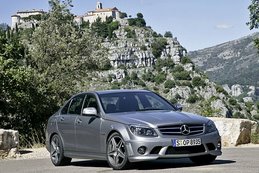
Newly Released C63 AMG

Thursday, July 5, 2007

Mercedes-Benz C63 AMG & Rivals (Opinion Piece)

Tuesday, the 2nd of July, was a very important day for Mercedes-Benz fans such as myself. Why you ask? Well, that was the day when Mercedes released its brand new M3 fighter, the C63 AMG.


How do I feel it compares to it's upcoming and current rivals?
BMW M3 vs Lexus IS-F vs Audi RS4 vs Mercedes-Benz C63 AMG

As is obvious, I have no real experience with any of these vehicles but I'll happily offer my first impressions.

Design Analysis:

Audi RS4:
I'm happy to say that I've been a fan of the RS4's exterior since the day it was released. Always appreciated the race-car flared wheel arches and while I'll admit to once questioning the need for a such a large front-end grill, it all now seems rather fitting complimenting Audi's new design direction. Nice design with nice selection of hard edged and smooth surfaced lines with the addition of sublime touches like: mesh grills; oval exhausts; chrome polished items; etc.

Positive: Just about everything..
Negative: The lack of coloured plastic through-out the tail lamps. It's all a little too red and doesn't fair to well when it contrasts against a red body.

BMW M3 Coupe:
Hmm, what is there to say about the E92 M3? Honestly, I cannot say that am I'm overly impressed with its exterior design as it all seems rather overly uninspiring, and rather unimaginative. BMW (and its fans) refer to the 3-Series as 'svelte', but personally, this is not an attribute which I feel works well on this vehicle. If anything, it's all a little too svelte for my tastes and while this M3 benefits from a number of so-called body 'improvements', I can't say that I am pleased with any of them.

Positive: Stubby nose and uhh..
Negative: Hood scoop; mirror design; rear airtray/undertray diffuser; lack of hard lines

Lexus IS-F:
Oh God, where do I start? Well, I'll start by saying what I said on GermanCarZone: "The transformation is something like a good-looking chick (the regular IS) who thought that she wasn't good looking and then decided to destroy herself (IS-F) by overtanning, while overusing botox and adding 48DD silicon breasts." I feel that certain aspects of the design are very much disproportioned and bloated. The addition of those front-end flared wheel arches and nose heavy front undoubtedly give the car an unbalanced look. However, one particular aspect of this design that I do appreciate is the rear-end and its quad assembled exhausts. Hopefully the design will look better in the flesh (but I'm not counting on it..)

Positive: Quad assembled exhausts
Negative: Thanks to it's body add-ons and what-not, the IS design now looks frumpy, clumsy & bloated.

Mercedes-Benz C63 AMG:
While I'll admit that the standard C-Class didn't do a whole lot for me, I must say that the C63 sure as hell does. The new C63 AMG manages to carry a recent tradition of AMG vehicles: it looks as if it directly came out of Mercedes' motorsport factory. The addition of the wider track at the front end with it's DTM-inspired wheel arches and redesigned front air dam means the C63 portrays a character far more aggressive than the others in this competition. Thankfully, I feel that AMG has been able to retain the smooth and elegant lines of the standard model while adding everything that was necessary (and vice versa). Top notch job

Positive: Just about everything
Negative: Rear-end looks a little short in certain pictures

Head to Head

Engines:
As I have no experience with any of these vehicles, I cannot make judgment to say which of the four boasts the best engine, I will however say that I don't believe there is a 'best' among the four. Let's face it, all four of these vehicles offer excellent engines with great strengths respective of their brands.

Interior:
Unfortunately, this is where I believe the Mercedes-Benz gets trampled. I feel its interior is a step behind the other three and it's not even that bad, but it most certainly could have been better! Ahead of the C63, I'd place the M3 and that of course would indicate that I believe the IS-F and RS4 are dueling it out for the 'best interior award'.


Head to Head

Verdict:
4th: Lexus IS-F
3rd: BMW M3

That all being said, it's down to the Audi and the Mercedes-Benz and my choice is? The C63 please. Sure, its interior is most certainly behind that of the RS4 and it isn't available with a coventional manual (like the RS4). However, you do get: RWD; an agressive DTM inspired body design; an AMG masterpiece for an engine and lastly, but certainly not least, an all-enticing 7-speed AMG automatic transmission with a selectable manual
mode.
Love at first sight? Yup!