Showing posts with label German. Show all posts

Friday, December 14, 2007

GT-R Meets Turbo

Courtesy of Edmunds - Inside Line


Wouldn't think twice about the subject: GT-R please!

Tuesday, November 20, 2007

ISDERA: The History

By Bruce McCulloch

The early 1990’s were an overtly awful time for supercar manufacturers, especially those with little history or prestige behind their names. Our market today is strongly fuelled with a vast amount of "specialty" manufacturers such as Pagani, Koenigsegg, Ascari and Wiesmann, but the supercar market back than was mainly driven by well-established auto firms such as Porsche and Ferrari.

Those who were new to the business, or at least relatively new, were having a hard time at establishing a proper market. Manufacturers such as McLaren Motor-Cars – developer of the awe-inspiring 240mph "F1" - and Jaguar, with their XJ220, soon found out that there was truly little market to be captured. And most, if not all of the companies with little prestige or universal acceptance, had to soon start looking at filing bankruptcy.

In those problematic years: Bugatti went bust in 1993; "Cizeta" producer of the "Cizeta-Moroder V16T" was shutdown in 1994 after a series of issues related to production costs, and even Gerald Wiegert’s "Vector Aeromotive" automobile company had to close shop in the early 90’s due to lack of sufficient funding – though to be fair, they were later resurrected.

And with all of the trouble, some even believed that the 1990’s were the death of the supercar. Myself? Well, it was a little before my time, but ain’t it funny to look back on it these days? Our current high-performance/supercar market resembles a pack of hungry wolves; and it keeps getting more and more competitive.

But out of all of those who suffered the 1990’s supercar-success drought, it’s the fall of a small sports car manufacturer founded in Hildesheim, Germany by one Eberhard Schulz which bothers me the most.

"Isdera" is the company, and they’ve created some of the world’s most interesting and visionary sports cars.

The history behind this evocative company actually harks back to 1969 when company founder, Mr. Schulz, designed a prototype race car – named the "Isdera Erator GTE" - with a tubular frame and a carbon fibre chassis. The name "Isdera" standing for an acronym of various words: I for "Ingenieurbuero" (German for engineering) S for Styling, D for Design and R, for Racing.

Mercedes-Benz C111


He hadn’t been known for a whole lot up until this point, but when he invented this formula of engineering for a sports car, he hit it big. So big in fact, that in the late sixties, Mr. Schulz was afforded the opportunity to oversee a series of Mercedes-Benz prototypes – starting with the mid-engined, rotary powered "C111". Shortly thereafter, Eberhard joined Porsche in 1971 as a design engineer to primarily to study upon the exterior styling of the companies future vehicles.

In 1978, however, Eberhard with his new-found knowledge and appreciation for sports car engineering, decided that he’d leave Porsche and fullfill his dream to create his very own company. But before he pursued his dream, he spent the remainder of the next five years working closer and closer with Mercedes-Benz. Even still, many of his designs and creative work still hadn’t been presented to the automotive market; and he was unknown to the public, in other words, Eberhard was still very much a design engineer behind the scenes with little appearance and mention in the automotive journalism and what-not.

But Eberhard's hard work was about to pay off. His most well known project design comes from the Mercedes design study referred to the "CW 311". Originally destined with an aerodynamic value of just .311 CW, it was set to be the first true successor to the Rotary Powered C111 of the late sixties. When Schulz presented his final design to Mercedes in 1978, they were so awe-struck with the design that they allowed the car to wear a Mercedes-Benz badge


Problem was, it was to only be seen as a "prototype concept", and not something that Mercedes was going to take the time to actually produce and set loose on the road. Eberhard, obviously proud of his own design and annoyed by Mercedes' choice not to put the vehicle in production, decided that he'd now make "Isdera", a true automotive company with its very own model. And in 1983, Eberhard’s dream came true when Isdera became a both a self-operated & self-owned business.

Tidbit: the eagle in the Isdera's badge is meant to pay homage to the aircraft workshop that the company occupied during it's life time.

Borrowing upon the CW 311's design study, Eberhard was able to slightly redesign the car for road use and ultimately, avoid possible design copyright issues. The company's first car was the "Spyder 036i", and further improving upon his connections with Mercedes-Benz, Eberhard got his hands on a Mercedes' 3.6 litre straight 6 motor -hence the vehicle's name - which powered the 036i. Though arguably, Eberhard's most famous work with his company comes from the car that was released in 1984, the "Imperator 108i". Bearing an even great resemblance to the CW 311, the 108i was an even bigger hit for Schulz - even though just 30 were built.


Employing the same 5.0 litre 8-Cylinder motor from Mercedes-Benz's 500SEC, the 108i had around 350bhp, 320lb-ft of torque and performance figures such as a 176mph (283 km/h)** top speed and a 0-62 mph (0-100km/h) time of just 5.0** seconds dead. For its day, it was incredibly fast, and in all fairness, it's still pretty darn fast by today's standards.


And after a 3 year period of building both the 036i and 108i, Isdera released yet another vehicle - this time, one called the "Imperator 033i Spyder". In all intent and purposes, it was more or less a convertible version of the 108i; same engine, same mechanicals, but still utterly fantastic.

Suffice to say, the 80's were very prosperous for Mr. Schulz. It all looked very bright for Isdera, and while existing models sold at a slow and steady rate, Eberhard had already been spending all of his time and money - somewhere around €4 million - to develop a new car to be released in the 1990's. Eberhard had the idea to make something unique, something truly advanced and sophisticated for it's time. Though it was undoubtedly his most advanced project, it is most probably the reason the company eventually went bankrupt.

But the thing about Eberhard was that he always was a true visionary; not one who liked to sit back and maintain the status quo. For him, the greatest pleasure was gained in creating new design projects; projects that would redefine what we know as sports cars. And in 1993, his newest and undoubtedly most amazing road car was released. And even though this car was all German, it boasted the name "Commendatore 112i", which was actually a tribute to Enzo Ferrari, who had become known as "Commendatore" or "the monk of Maranello" throughout Europe.

Fitting with previous Isdera projects, the C112i was a technical masterpiece; but more specifically, an aerodynamic technical masterpiece.

In terms of its design styling, it's quite obvious that Schulz's C112 owes much to previous Porsche motor cars. If you ask me, the 112i looks to borrow much inspiration from not only Porsche race cars such as the "917", but even such road versions of the late 80's generation of the 911 (the "930").

Tidbit: The headlamps of the 112i are in fact borrowed from that of Porsche's early 90's "968" coupe.


This vehicle in my humble opinion is the pinnacle of his design work. It's a car which was certain to make most any sports car enthusiast's jaw hit the floor. It's very clean and imposing, but aerodynamically efficient; one of the best supercar designs ever as far as I'm concerned. And with a whole host of features like two gullwing engine compartment doors, and an overall extensive use of "green house" glass, the 112i was, and still is quite unlike anything else on the road.

But of course, you can't talk about the 112i without mentioning its great technological advances. It's rear spoiler for instance, automatically adjusted itself to the speed of the vehicle and additionally served a functional purpose as an air brake; the latter of which was unheard of on a road vehicle for the time. Even the suspension was automatically adjustable to speed thus improving both the vehicle's stability and handling at high speeds; all thanks to a velocity-sensitive electronic chassis lowering the car a full three inches.

Tidbit: The C112i shares the same 5-speed Getrag transmission found in the 930-generation 911 Turbo

As for the interior of the vehicle, well, there really isn't one. It's just a collection of hard plastics, with classic square-edged 1990's cabin architecture. Of course, back in the day it was probably the thing, but its interior hasn't aged too gracefully. Yet despite that, I wouldn't have it any other way as it’s truly contemporary to such a car.

And inasmuch as Isdera's component sourcing from Mercedes-Benz had continued to be highly valued, Eberhard had little reason to search elsewhere for an engine to power his new beast. After all, the Mercedes-Benz engines were not only reliable and durable, but powerful and even gave off a bit of prestige to a brand which, even at this point, had very little. Wanting to hasten the C112's advancement into the supercar world, Eberhard got his hands on Mercedes’ latest - at the time – a 6.0 litre, 48 valve, 12-cylinder motor. It was an engine that in this particular stage of tuning was churning out 408PS (402bhp) and some 427lb-ft of torque. Performance figures were as claimed: 0-60 in 4.7 seconds, and a top speed a bar-boasting 205+ mph (330+ km/h). In all honestly though, those performance figures weren't particularly impressive for a 1990's supercar. Though the fact that the 112i was a full 441lbs (200kg) heavier than the 108i didn't help... Anything with a similar price would have knocked it down the hill, but I couldn't care about that either as the allure of this car is not just raw performance numbers.

Tidbit: oddly enough, this exact engine (codenamed the "M120") found its way into the Pagani Zonda C12 in 1999, and is the same basic engine which powers the larger, more powerful Zonda iterations; such as the 7.0 and 7.3 litre engined-cars in the Pagani lineup like the Zonda S and Zonda F.

Shortly after the C112's prototype release in Geneva, Eberhard was forced to close shop as it was no longer financially sound to keep the company running. One has to wonder whether the company would have gone bankrupt if Eberhard hadn't spent so much money to develop the C112. Though, even if it did mean the death of the company, I'm glad enthusiasts got to see a vehicle as spectacular as the C112 was.

The Road-Working Prototype:

In October of 2005, the sole working C112 prototype was offered on eBay for no less than $4.8 million dollars. But with little prestige, nor any real footing in the supercar world, it failed to sell. At the time the car was located in Switzerland, but strangely, only road-legal in Germany.
The vehicle itself was more or less the original with a few modifications; those being a new steering wheel, new alloy wheels, an engine borrowed from a Formula One vehicle (the brand of which was never revealed) and a few other tiny features.

Isdera's Future & Closing Thoughts

After Isdera's bankruptcy back in 1993, the remainder of the company was sold to a Swiss interest, but it was not heard from again until August of 2006 when the company made a blip on the radar yet again. And though it is indeed possible that the company could make a revival in future years, things aren't looking too favourable for the company at this time, since they have lost a recorded $73,212 since their revival due to lack of activity and shareholders backing out.

Can Isdera ever make a proper comeback? Can they? Should they?

Well, I most certainly hope so. There's no doubt that Mr. Schulz wasn't the best businessman, but he was one hell of a visionary; an artist, an engineer - an all-out brilliant man.

** Tested by German magazine "Auto Motor und Sport"

Wednesday, November 14, 2007

Porsche: The Five Most Beautiful

By Bruce McCulloch

With around 70 years of history behind Porsche at this point, choosing just five Porsche automobiles as the most beautiful of all isn't an easy task. Oh no, in fact it's downright daunting. This is one instance where one must take into account not only every little detail, but every little niggle and nanny in approaching a general design philosophy and theme which the company has stood behind for the better part of the last 7 decades.

The Porsche design element is one which is unmistakable - especially when it comes to the 911. Aside from what is referred to as "Hitler’s revenge" - the Beetle - the 911 is pretty much one of a kind. It's unmistakable, unique and ultimately, iconic. And that being said, many of the 911's design elements have insinuated themselves into almost every other vehicle which has rolled out of the iconic gates in Stuttgart. It's a trademark look which is hard to explain with words, but clearly evident when one looks at the Porsche line-up; many of the models not branded with the eminent "911" moniker still share a family trait (or two) in appearance which is not the least bit surprising.

Even Porsche's 605bhp "Carrera GT" flagship, shares what would appear to be the same styling manner which the company's 550 Spyder sported back in the late 50's. And now-a-days, both the Boxster and Cayman - even the Cayenne - seem to have a "Porsche vibe" to them. And this is obviously something Porsche as a company has strived to perfect with every passing year; with each and successive generation of Porsche automobiles, they have the utmost unique ability to make a design fresh and modern, while retaining the design values and design cues which have made the company so successful.

And suffice to say, it's something that makes Porsche, well, Porsche. One doesn't buy a Porsche hoping it’ll look like a Ferrari, one buys a Porsche knowing they are getting a vehicle which embodies every stylistic detailing element the company has ever penned. It's a design spirit which stands alone among modern cars, and in this day and age, truly one of a kind.

Mind you, such a design philosophy is often under criticism as some enthusiasts complain that is exactly what is wrong with Porsche; that they all look too similar, that they’re bland and boring to gaze upon. Not surprisingly, I strongly disagree with such.

In any event, with output that is approaching nearly 100 different automobiles from this great company, which five are deserving of such a “best of” title? Well, here's what I think - chronologically ordered:

904 Carrera GTS (1964)


For a car which debuted in 1964 as a sports-car endurance racer, the 904 looks every bit as fresh today as it did the day it was released. It is a gob-smackingly good looking car. Unfortunately, information relating to its design is quite rare, but I think the picture speaks for it’s self.

930 Slant-Nose (1987)


Though up until the early 80's the 911 had been viewed as the cute and quirky sports car with circular headlamps, the flachbau - or "Slant-Nose" as we know it - shows that little work was required to turn the 911 into something truly more aggressive. Commissioned in 1981 by Rolf Sprenger and ordered through the specialist individual "“Porsche Exclusiv Programme”, the Slant-Nose is undoubtedly one of the most interesting vehicles to ever roll out of Stuttgart.

With a body inspired by that of the 1976 "935" racer, the Flat-Nose looks every bit the race car with its hard-edged, flat bumper bonnet design, and with the addition of what was then new sporty "air vents", "rear spoiler" and "integrated driving lamps”, it's little wonder why the Slat-Nose makes it on this list. Suffice to say, there ain't a 911 like it anywhere.

993 Turbo - (1997)


Though the 930 and 964 generations of the 911 were some of the most iconic styles of all time, the 993 - particularly the Turbo version - marks what is arguably the best looking 911 ever designed. It's a design that even after 10 years since it's release, has been able to withstand the test of time; even today, it looks fresh, modern and ultimately, Porsche-like. And as far as I'm concerned, the 993's Turbo's design is so spectacular, that it's not only one of the best-looking Porsches ever assembled, but one of the best designs anywhere. With a front end suggesting a 911 design evolution, a slightly quirky silhouette and a rear end with accentuated fenders, a large body-attached spoiler and a distinctive light bar, the 993 Turbo is the most exceptional version of one of the world's most iconic vehicles.

993 GT1 "Strasseversion” (1996)


It's not often that I get worked up about a homologation special, but the 933 GT1 is the perfect example of road vehicle finely blended with a racing car. It's unquestionably from the 911 family, but makes the transition in a manner which is completely unique. Sure, being insanely long and wide, and having no rear window, it might be absolutely absurd to drive it on the road, but hell, I wouldn't mind. It's an angry and bulked-up 911 on steroids, and it's just great.

Carrera GT - (2004)


It's largely accepted that most supercars of this sort have designs which are often compromised for aerodynamic efficiency. And with vehicles such as the Ferrari Enzo running around, how could one argue? The Enzo is a vast, almost tortured array of Formula One-inspired hard edges - all for the sake of keeping the car aerodynamically efficient. The Carrera GT though, is very much a different story; rather being an edgy and hard-to-digest shape, it's clean and undoubtedly Porsche. And there are no compromises about it - the Carrera GT looks 100% Porsche. It's aerodynamically efficient, without alienating any of the company's classical design traits. From it's smoothly and fastidiously styled front end, to it's rear-end profile boasting a carbon fibre undertray, a retractable wing and an exquisite set of mesh engine grills setting above the 10-Cylinder motor, this exclusive flagship supercar is styled like few other comparable cars. It manages to look all-racy, without being the least bit boy-racer or over-the-top.

The design detailing of the Carrera GT is also particularly interesting because it showcases a number of styling elements found in the company's past; one of the most evident examples being the brake cooling slots behind that of the front wheels which are near identical to those seen on the 993 GT1 which I previously spoke of.

So, there you have it – the Fabulous Five.

Sunday, September 30, 2007

"Efficient Dynamics"

By Bruce McCulloch

That, folks, is what BMW calls protecting the environment; building more fuel-efficient and earth-friendly “eco” cars. Rather than sticking to the usual catch phrases of having their vehicles named such things as “LEV” (Low Emissions Vehicle), BMW deems such a name necessary to separate themselves from most every other company who practice the identical, uh, practice.

Mind you, this is not limited to their ideals and practices on emissions, but most everything; as of late, BMW has had the great tendency to label every basic and simple technological invention with some special name; and quite frankly, it’s a marketing gimmick which is just starting to piss me off.

Now, let us take a look at the many BMW marketing names.

“Active Hybrid”:
Rather than the simple approach at calling their upcoming hybrid system a mere “Hybrid”, it just has to be an “Active Hybrid”. So then, am I supposed to believe that hybrids developed by that of Toyota and Co. are non-active?

Furthermore, BMW says the Active Hybrid version of the X6 will feature “a high-performance battery” and a “high-efficiency combustion engine”. Now quite frankly, this is bunch of doo-hickey.

“SAV”:
Sport Utility Vehicle (AKA “SUV”) used to be a hot type of vehicle, but it’s now a thing of the past and that’s why BMW chooses to label its X5 and X3 with the name of “SAV”. And thus indicates “Sport Activity Vehicle” - because it’s oh-so-good to advertise something that gives you an “active lifestyle”. Oh, please...

“SAC”:
With BMW’s upcoming sporty X6 (the concept of which was seen at Frankfurt), BMW thought neither “SUV”, nor “SAV” was appropriate. No, instead the swoopy X6 is called an “SAC”. This indicates “Sport Activity Coupe” and you know, that’s really great considering the vehicle has four doors and is a 4X4 – no matter how pointless it is as one, but then that’s just about right for all “performance” SUVs and a whole 'nother ball of wax…

“PAS”:
BMW’s next addition to their lineup – codenamed the V5 with production slated for 2009 – will wear the acronym of “PAS”. And like previous mock-ups, this has some sort of deep meaning, or at least BMW would like to believe. “PAS” stands for “Progress Activity Sedan”. Which sort of reminds me of those inscrutable, tortured Chinese-to-English translations the Chinese are putting on their home-grown cars these days, and seems faintly ridiculous on a BMW.

And I’ve saved the absolute best for last,

“LCI”
What do you call a facelift of a vehicle? Well, I, like most everyone else, call it a “facelift” as it seems logical. But of course, that’s too simplistic, so BMW calls them “LCI”; or in other words, a “Life Cycle Impulsive”.

Now excuse me, but that’s completely idiotic. We all know that neither the true enthusiast, nor the poseur, is going to purchase any of these vehicles and call them any of the aforementioned. Additionally, our current market situation has a great deal of these vehicles selling themselves, even with stiff competition – so is there really a need for such linguistic embroidery?

And while we’re on the subject of marketing tactics from BMW, I’d like to mention my displeasure with the European brochure of the M3 that I recently got the opportunity to read. In this particular brochure BMW employs a series of aggressive marketing tactics to make its competition look weak-minded. And for comparison, they’ve focused on three other entities; the Porsche 911, the Audi RS4 and the Mercedes-Benz CLK63 AMG.

In the case of the 911, BMW’s strategy is to acknowledge the 911’s greatness as a sports car, but make note of its lack of usability as a daily driver because of its tiny rear seats and small boot space. And whilst the boot space is small and the rear seats tiny, a large number of 911 owners would argue that their car can comfortably be used as a daily driver. Yes, it’s most likely not as good as a daily driver as the M3, but is there really a need to make such a dramatic attempt at downplaying the competition?

And it doesn’t tone down as they give their expert insight on both the Audi RS4 and Mercedes-Benz CLK63 AMG. Their Ingolstadt rival takes a further beating when BMW insinuates that they themselves pioneered “the high revving engine concept”, and that Audi is clearly following their path. Additionally, they’re sure to mention the M3’s significant (lower) weight advantage over the RS4 due to the Audi’s implementation of AWD – which BMW claims has an effect on the RS4’s steering, labeling this “palpable”.

As for the CLK63 AMG, well, it takes the blunt side of the shovel when BMW claims the CLK63 is nothing but a GT car with an engine which is relatively un-interesting and a transmission which suffers from “long-legged ratios”. They finish the CLK63’s description with, “but it does not have the thoroughbred genes of the sports car”. What makes that particular quote quite idiotic is that BMW themselves explained throughout the first two sentences of the CLK’s description about how a GT car should be weighted towards comfort as opposed to sport and how this perfectly caters to the company’s customers.

Truth is, there isn’t much which BMW states that is untrue – the CLK63 is a GT, the RS4 is heavier than the M3 and the 911 is a slight less practical – but I simply cannot understand why BMW takes such aggressive marketing tactics. Companies that are reduced to making their competitors look weak generally resort to this because their product is not strong enough to stand on its own merits. This is not the case with BMW – despite the goofy names for their technology and their cars, they generally make fine vehicles. And it’s not like they have to worry about sales and what-not; after all, this is a company which on average, sells 10,000 3-Series every month in North America. Perhaps I’m just a nitpicker, but I personally find this tactic a bit much.

This strategy, combined with the aforementioned, increasingly idiotic naming conventions, has made me unhappy with BMW as of late. This is a company that occupies the rarefied air at the top of the automotive industry and it is employing cheap marketing tricks and insulting their able competitors. To me, it’s all a bit unseemly and shows poor form.

Sunday, September 16, 2007

Wiesmann MF5 GT Arrives (again)

By Bruce McCulloch

FRANKFURT: You may recall that just a few days ago I wrote a short piece on Wiesmann’s up and coming “MF5” flagship supercar. At the time at which that was written little was known about how much the vehicle would differ from its counterpart, but the time of pondering has come to an end as Wiesmann has now released the final details of the vehicle.

So then, what shall we start with? Well, how about the “revealing” of the new car. Many, including myself, had assumed that Wiesmann was to release the MF5 at the Frankfurt Autoshow, but that turned out to be untrue. Rather than renting out a spot at Germany’s most prestige Autoshow, Wiesmann deemed it more than appropriate to rent out the bottom half of the Frankfurt’s “lighttower” on the main street of the German city. A private, more organized showing; yes, but certainly not a coincidence that they decided to reveal it in the town of Frankfurt during Autoshow week. So, PR tricks and all, let us get to the actual vehicle:

If wanting to turn heads is your thing, the new MF5 will not fail to deliver as it looks like nothing else. It’s blunt, angry, aggressive and above all else, racy. There’s little doubt in my mind that Wiesmann’s goal was to make the MF5 visually as close as possible to their successful GT race car. And I had suspected upon first glance of the vehicle that it had notably grown in size over its counterpart and indeed, it has; the MF5 is 5 cm lower, 9.6 cm wider, 8 cm longer and lastly, features modifications in width to both the front and rear track.

The changes are evident too; deeper front facia, various air-vents amongst the body and a rear end that looks like something out of a cartoon. Notable are the spoiler – made from nothing other than carbon fibre – and a redesigned undertray diffuser intended to help the MF5 keep it controlled at the amazing speeds which it’s able to achieve. And trust me, you’ll need it.

You’ll need it because as I’ve mentioned before, this car has the same 10-cylinder motor from the BMW M5 and M6. In short, that means a 12.1 compression ratio, 507bhp, 384lb-ft of torque (or 520 Newton Metres) and a wonderful redline of 8,250 rpm.

I had previously speculated on what transmission the MF5 would be using; perhaps thinking Wiesmann would offer both a manual and a sequential transmission for the vehicle – as they had done with previous vehicles. However, it would turn out that the MF5 is only available with BMW’s 7-speed sequential SMG transmission. Still, having SMG to play with in a 507bhp supercar can hardly be a vice…

One big and obvious push with the MF5’s release is Wiesmann’s business philosophy in making sure it’s road-worthy and more importantly, safe. Thus is why this vehicle boasts a whole level of features not available on previous models: “Dynamic Stability Control” (DSC), “integrated side-collision protection”, “3 point seat belts” and a whole host of other features likely to keep you alive, if not unscathed, should you slide off the road. And to back it up, all of these systems have been developed by the great conglomerate that is BMW. Not unique to Wiesmann, the specialty car manufacturer, some one-off fans might query? True, but tried and tested by one of the foremost car companies in the world, with superb engineering resources at their disposal, so you know it will work when it needs to, and that’s fine with me.

As for the interior, well, modifications are mostly vacant, but that still hasn’t stopped the small manufacturer from further improving upon the vehicle. Notably, the MF5 comes standard with driver and passenger airbags – something never available on any previous Wiesmann – as well as redesigned bucket seats with supposed “excellent lateral support”. Also worth mentioning is that these seats are made to order, and designed to fit each and every customer. Should that not be enough incentive to purchase one of these, you’ll be glad to learn that one can order special seats made from carbon fibre basing - which are of course lighter.

Suffice to say, the addition of the large 10-cylinder motor and various safety components, the MF5 has gained some 140kg over its counterparts; 1240 vs 1380kg, MF4 vs MF5 respectively. Nevertheless, 100 km/h (62 mph) is promised to take just 3.9 seconds.

So there you have it – should you have the desire; and above all else, the money to purchase something rare (just 25 are expected), powerful, fast and wacky, this is a great choice. Production is set to start in the spring time of 2008, but be prepared, starting prices commence at a base of 178,900€, and, of course, go up.

Wednesday, September 12, 2007

Wiesmann MF5 GT Arrives

Transmission: M Division's "SMG"
Production: ca. 25
Base list price: EUR 180.000,--
With Ceramic brakes: EUR 200.000
Car eqquiped with driver-air bag


Tuesday, September 11, 2007

Comin' Up - Wiesmann MF5

By Bruce McCulloch

Prepare to rev ‘em up, gentlemen.

With the 2007 Frankfurt Autoshow now upon us, German tuner-car and automobile manufacturing company, Wiesmann, is preparing to launch an all new flagship called the “MF5”. Based upon the lesser “MF4”, Wiesmann’s new (and apparently limited production) supercar is set to take the company to a new level of status, exclusivity, and ultimately, performance. Wiesmann Automotive will now have a vehicle to compete with mid-engine wonders like the 483bhp Ferrari F430 and front-engine behemoths like the 505bhp Chevrolet Corvette Z06.

As the official show has yet to open, little is known of how different this new GT will be from its regular counterpart, but we can at least get an idea with the aforementioned picture. Evidently, Wiesmann’s reworking of the front facia and headlamps have left the quirky and almost English-like MF looking far sinister than it has every before; whereas the MF4 was more about exquisite detailing, the MF5 makes no apologies for looking like it just rolled out of the racing department.

Mind you, as the MF4 was already turning heads, styling updates are hardly what it needed; nevertheless, it’s nice that they decided to throw in some extra eye-candy for the expected 30k+ premium over the standard model.

The real delight of this car will be its engine, which is the same one you’ll find in BMW’s M5 and M6 variants. Make no mistake; it’s a large leap from the existing model which is currently running on BMW’s 4.8 litre 8-Cylinder with 367bhp. This 10-cylinder motor boasts 5.0 litres, an 8,250 rpm redline, 507 bhp and 384 lb-ft of torque which peaks at 6,000 rpm. Already praised and recognized as one of the best engines on the market, have no doubts that in a car weighing less than 1300kg, it’ll be able to take most any individual to the moon and back.


What is unclear at the moment is whether the MF5 will adapt the M Division’s “SMG” transmission. Although, considering that Wiesmann’s own MF3 (the roadster version powered by E46 M3’s straight six) borrows upon the option of an SMG gearbox, it’s very likely. Having said that, it’s also very likely that Wiesmann will let its buyers opt between the highly advanced and technological wonder of “SMG” and a conventional (and perhaps old-fashioned) 6-speed. And if so, I’ll take the latter…

And to further awe us, Wiesmann chose that light blue – arguably the funkiest of all colours – to reveal the car to the public. Stay tuned as more news will leak from Frankfurt
!

Tuesday, August 14, 2007

DMAX D-Motor: Marcos TSO GT2

From the German automotive show "DMAX D-Motor". Driving this British war-horse is the fantastic Tim Schrick.

Enjoy!


Sunday, July 8, 2007

Renaissance

And it was a long time coming...

By Bruce McCulloch

I cannot help but tip my hat to the folks not only at the performance division that is AMG, but to Mercedes-Benz themselves. Why, you ask?

For the longest of time, we Mercedes-Benz fans have had to live with one hard fact and that fact was that Mercedes-Benz products couldn’t quite offer the excitement, or entertainment (as drivers’ cars) when compared to their Munich rival, BMW. Admittedly these two manufacturers have never really appealed to the same type of buyer, but the rivalry is far too blatant to be hidden. Fans of both of the iconic manufacturers have been at ‘war’ (so to speak) for a long time, but that over-used cliché that Mercedes-Benz only makes products for the elderly seeking a vehicle with lush ride and no driving experience is fading away – extremely fast.

As Bob Dylan once said, “The Times They Are A-Changin'’”. They most certainly are for Mercedes-Benz and affiliates who are currently gaining a reputation for developing ‘sporty cars’. Now I know what you’re thinking, aren’t the words ‘Mercedes’ and ‘sporty’, a contradiction? Contrary to what some may believe, such a combination is not a contradiction and the recent flood of complimentary magazine reviews confirms this to be the case.

However, before we move onto to the actual praise of the newer AMG models, I think it’s only fair to mention some of Mercedes-Benz’s greatest drivers’ cars. People often label Mercedes-Benz as a manufacturer with no sporting intent, but excuse me, that’s just rubbish.

Mercedes motor sport-inspired road-going models actually hark back as far as the 1950’s - the most notable of them being the 1954 300 SL “Gullwing”. The iconic 300SL Gullwing was one of the Mercedes’ first road-going automobiles which was labelled as a ‘road-legal race car’ – evidenced by the fact that it was loosely based upon the company’s 1950 race car, the W194 300SL.

The following years saw a steady trend of Mercedes road-going race cars, but none that made as much of an impact on enthusiasts as the release of the 190E 2.5-16 ‘Evolution’ models – the first of which was released in March of 1989. Aside from an obvious body make-over (inspired by Mercedes’ own DTM vehicles, allowing a drag coefficient of just .29), the Evolution took Mercedes to a whole new level by settling itself firmly in the sports sedan section. This was achieved through the addition of such equipment as a: short-stroke engine with a bigger-bore (thus increasing the flexibility and revv band); an adjustable suspension with adjustable ride height; and just about everything thing else you could think of that was available at the time. And to top it off, the 190 Evolution was a homologation special, and that alone secured it a place in Mercedes history.

190E 2.5-16 Evolution II

What made this particular vehicle first popular, and subsequently legendary, was it’s ability to please it’s driver like few before it. Problem was, we Mercedes fans didn’t see much anything with the allure or special traits of that Stuttgart classic for an unbelievably long 16 years. Sure, Mercedes had a few attempts along that nearly two-decade timeline, none of which lived up to the Evolution name, but, thanks to the release of a homologation special in 2005, this sporting trait was brought back to life once again. The vehicle? Why of course, it was the one and only ‘CLK DTM’.

Wait just a minute! Before you go and utter words such as, “Mr. McCulloch, have you forgotten about the supercar that McLaren motorcars co-developed with Mercedes-Benz? What about the eye catching, carbon fibre-bodied 626bhp monster that is the SLR McLaren?”

No, I haven’t forgotten about it. The SLR may be superbly fast and an amazing performance car, but truthfully, it’s just a big GT (no pun intended). What you should be aware is that even Mercedes themselves doesn’t advertise the SLR as a sportscar, but rather a high performance GT and having said that, it’s clear that various magazines agree with their analogy. British magazine EVO was quoted as saying that they’d rather own the CLK DTM than the SLR, mostly because it boasted a level of driving excitement which the SLR could not match.

This particular vehicle was brought to life in mid 2004 when Mercedes-Benz motorsport division (in connection with AMG), decided to produce a homologation special with no marketing logic whatsoever. Mind you, the words ‘homolgation’ and ‘logical’ have never gone hand in hand, but let’s be honest – 236,060 € for a vehicle (and a Mercedes, after all!) which shared the same base 5.4 litre supercharged 8-cylinder with a number of lesser AMG models and a body style loosely based on the road-going CLK doesn’t fare too well on paper. In fact, most enthusiasts questioned the need for such a vehicle - often implying that it was no more than a standard CLK with a power boost. Nevertheless, such an intial reaction did not affect Mercedes who managed to sell the entire production line (100 units), before any automotive journalists got their hands on the vehicle.

572bhp CLK DTM


Furthermore, the performance figures which this monster eventually turned out surely shocked the majority of sports car enthusiasts. The CLK DTM easily broke the 8-minute barrier on the famous Nurburgring Nordschliefe and matched the best from Italy, Germany and America when it came to slalom courses, braking tests, etc. Once the word spread, those familiar with Mercedes history soon knew that something was a little different this time around. After all, this vehicle had a few advantages which no other Benz could offer, like semi-slick tyres and a stripped out interior full of lightweight bits made of materials such as alcantara and carbon fibre. Far from being the answer to a question no one asked, as auto enthusiasts originally conjectured, the CLK DTM is instead the answer to the prayers every Mercedes-Benz enthusiast had uttered for years.

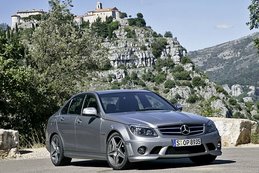
Thankfully the wonderful CLK DTM has paved the way for a new generation of AMG and Mercedes models. Since the release of the homologation special, the magic has been passed along to other AMG models. They include the SLK55 AMG Black Series; CLK63 AMG Black Series and the recently released, M3 fighting, C63 AMG.


Black Series models, CLK63 (top), SLK55 (bottom)

And yep, you guessed it; all three of these vehicles have Mercedes being considered in a much different light. With respect to the C63 AMG, British magazine AutoCar recently made the claim,"I can’t remember a more entertaining, a more dynamically rounded Mercedes model since the original 190 2.5 Evo." Big claim, wouldn’t you say?

Make no mistake; both Mercedes and AMG are evolving and what makes this achievement even all more impressive is that it appears they been able to do this without any compromises – without alienating the large group of customers that has always known and respected Mercedes for luxury motorcars.

BMW and Audi - watch out! Fair warning is being given right now. Stuttgart’s driving enthusiasts’ models are back and heading your way, at high speed, real soon.

Newly Released C63 AMG