skip to main |
skip to sidebar
 It’s not often that you hear the words “awful” and “supercar” in the same sentence. Actually, finding the word “awful” to describe a “supercar” is about as rare as finding someone who actually likes the repugnance of a Pontiac Aztek.
And it’s no wonder why, when purchasing a $200,000 automobile, the last thing you obviously expect is for it to be awful. But of course, there are those exceptions; those exceptions which manage to slip through the factory gates without a shred of engineering excellence - a dud, a lemon if you will.
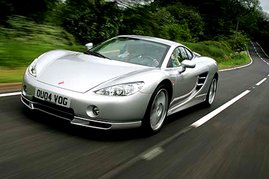
Thankfully, there are few of these wallet-crushers which could be described as being awful, but I’ve got one for you – there is no supercar as awful as the Aston Martin Vanquish. Here and now, we’ll take a look at what made the Vanquish so awful; its tribulations, its downfalls, its cost-saving operations.
After a some-ten-year life-time span of Aston’s flagship, the DB7, the time eventually came when with the help of Ford Motor Co. It was time to release a new vehicle. Something which would be able to compete with the average 21st century supercar; something which would have the brute power, the technology and the style to make it a true thoroughbred. Trouble is, the Vanquish was (and has) never been anything like that. And despite its bold name – which means to “annihilate or “forcibly subdue” – the Vanquish did quite just the opposite. It was never daring, never class-leading and seriously compromised because of Aston’s cash flow at the time.
The first of many problems was the styling, which as it was often criticized for being overly adventurous for an Aston. Designed by Ian Callum, designer of the DB7 and the new Jaguar XK, the Vanquish (apparently inspired by the DB4GT Zagato) was not smooth like the DB7, but more blatant – more aggressive, flashier. Of course, this is subjective and not a real problem per se, but this was an often-stated criticism of the Vanquish. Personally though, I could never concur. I always thought the Vanquish was always a great looking car - perhaps not as finely stated as the DB7, but still interesting and modern without alienating Aston Martin’s classical design philosophy.


Exterior preferences aside though, the Vanquish’s first of many downfalls was always its interior. Those who had previously been acquainted with Aston’s had come to know and love their rich and vicarious all-English thematic styling elements - the affluent and over polished woods, the hand stitched leather and well, the 20th century cabin architecture. And though such specific traits were often criticism of such vehicles as the DB7 and the Virage, it ultimately made them Astons. That’s what Aston’s were, until the Vanquish arrived.
Unlike previous Aston Martins which were really like stepping into a 19th century drawing room, engineers and designers had tried – with their limited resources – to make the Vanquish interior luxurious, as well as modern. Unfortunately, the results didn’t pan out as one had hoped. With the Vanquish there was no rich woods to be found, oh no, just a sculpted console supposedly formed with aluminium, or so they say. Instead of being classical Aston, the Vanquish’s interior was always a sub-par item; not good looking, nor well built. The centre console being the worst example with its vast array of Ford parts bin pieces – cheesy and tactless buttons, awful air vents, and an audio and climate system obviously borrowed from that of a much lesser automobile. So, the approximately $200,000 Aston Martin was noticeably shabby. Suffice to say, such was not expected from a marquee of such high stature.
Amazingly though, that’s not even the Vanquish’s real vice. The biggest of downfalls with the Vanquish was undoubtedly with its mechanicals. Like the engine for instance, which was essentially two Ford Mondeo Six’s lashed together. Though that’s not the real issue here, the real issue was the fact that the engine had 450bhp and some 400lb-ft of torque. Respectable figures at the time of its release, but it looks as it was all a little too late. The same year Aston released the Vanquish, Ferrari released an updated version of Maranello, the 575M. With a price tag near identical to the big Aston and an engine featuring 520bhp and 414lb-ft of torque, the Vanquish looked to be living in the stone-age. Mind you, that’s without even mentioning the 6.2 litre 580bhp Lamborghini Murcielago with a price tag also near identical to the Aston. So, pretty much from its release the Aston was over-priced, underpowered and cheaply assembled.
As a result, its straight line performance was always mostly inadequate. With an average 0-100 km/h (62 mph) sprint between 5.0 and 5.5 seconds, the Vanquish just wasn’t matching its similarly-priced competition, let alone a $90,000 Mercedes-Benz SL55. Also contributing to poor acceleration was a gargantuan kerbweight and what is arguably the worst sequential transmission ever built; the latter being the greatest criticism of the Vanquish. The first and foremost trouble was that the Magneti Marelli system featured no automatic mode like that of a DB9, or a Ferrari 599 GTB Fiorano. In the Vanquish, the only way to change gears was with the paddles and even that would be ok if they had just worked properly. All throughout the Vanquish’s life the transmission was always an unbelievable afterthought; it didn’t respond quickly to gear changes - often delaying upwards of two seconds. It was jerky, noisy and above all else, faulty.


Now, I know what exactly you’re thinking – “well, performance isn’t everything, how about the general driving experience”?
Well, you’d think that after a cheaply assembled interior, a faulty transmission, mediocre performance and a large kerbweight not much else could be worse, but you’d be wrong. The brakes proved to be under-sized, inadequate and likely to starting fading after a few laps on the track. And the handling, oh boy, where do you we start? The true essence of an Aston has never demanded precise handling (making a nose-heavy Aston Martin go fast was always a muscular achievement), but with the Vanquish you would have expected some sort of advancement. This was untrue though – the car was sloppy, uncontrollable and over-sized. Simply put, it just couldn’t pull its weight through the corners. And so on and so forth, the Vanquish proved to be just a big lug with lousy footwork. But in 2004, the Vanquish faced its hardest competition yet; the company’s newly released DB9. Borrowing upon the Vanquish’s 12 cylinder motor and general styling theme –albeit closer to the DB7 - the DB9 did everything better than the Vanquish. It was just as powerful, it was a tad faster; it was better-handling and certainly much better built. It’s transmission… actually worked. In short, it was everything the Vanquish should have always been, and with a price tag undercutting the Vanquish by a lump sum of some $50,000, there was now little point in purchasing the flagship.
Aston made note of this immediately and in 2005, released the “Vanquish S”. What was an apparently reworked Vanquish though, was just a pin-up. Despite featuring a supposedly “reworked transmission”, it still changed gears like a 16 year old using a manual for the first time. And despite a 70bhp power increase, tests revealed the car to have straight line performance more or less identical to that of the first Vanquish. In fairness and thanks to a stiffened chassis, it was said to handle better than the first generation though.
So here we are, in 2007, looking back at the vast mistake which the Vanquish was. A $200k dud. A mistake, an afterthought – a car which never lived up to being called a supercar, let alone an “Aston Martin”. Thankfully, the big Aston is no longer wasting factory space as it’s been discontinued, and rightly so. Long live the new DBS.
 As if recent news of the Pagani Zonda F Clubsport completing the Nürburgring Nordschliefe in 7:27.82 (see here) wasn’t enough of a shock, earlier today German publication “Sport Auto” announced that in their monthly “Supertest” the recently released 530bhp Porsche 911 GT2 has completed the Nordschliefe in 7 minutes, 33 seconds.
Such a figure indicates a new echelon in Porsche 911 history. Not only does this particular lap time match what Sport Auto driver Horst Von Saumra was able to do in the Pagani Zonda F, but it’s just a tad whisker – 1 second, actually - behind that of the Porsche Carrera GT which completed the Nordschliefe in 7:32.44 back in early 2005. Thus also means the RWD 911 flagship out performs other such supercars as the 806bhp Koenigsegg CCR, the 640bhp Lamborghini Murcielago LP640 - let alone its normal competition such as the Lamborghini Gallardo Superleggera and Chevrolet Corvette C6 Z06. In short, thanks to regular testing at the ‘Ring and Porsche’s great attention to engineering detail, the heavier and much less powerful 911 has been able to annihilate most every car that has previously run in the Supertest – regardless of the power, weight and/or price.

And of course, the new GT2 was able to erase the previous fastest 911 lap time of 7:46 - set in 2002 – with the 996-generation of the GT2
Additionally, Sport Auto’s Supertest revealed the GT2’s amazing cornering abilities as it peaked at 1.35G’s through the corners, and more or less made runny eggs of the both the Porsche Carrera GT and Pagani Zonda F throughout both the 18 and 36 metre slalom course. And as per usual, the frenetic 911 did not fail to shock when it came to straight line performance, hitting 200 km/h (124 mph) in just 11.5 seconds and hitting an indicated 293 km/h (182 mph) on the Dottinger Hohe straight line of the ‘Ring; just 1 km/h (.62 mph) short of the Carrera GT and some 12 km/h (7 mph) faster than the Zonda F.
Suffice to say, Porsche engineers deserve mad props. With each and every successive generation of the 911, just when you think they’ve hit the peak, they manage to out-do themselves.
 By Bruce McCulloch It would appear that the near-thirteen mile Nürburgring Nordschliefe circuit has a new king.
According to English publication “EVO”, Pagani Automobili and their fabulous Zonda F “Clubsport” – a faster, more taut and powerful version of the regular unit – has finally stolen the long held crown from the Porsche Carrera GT.
Porsche’s $450,000 flagship had reportedly set a lap time of 7 minutes, 28 seconds with the company’s master test driver, Walter Röhrl at the helm in 2004. Meanwhile, shortly thereafter, well-respected German publication Sport Auto was eventually given the chance to set a lap time themselves, and with racing-trained driver Horst Von Saumra at the wheel, the magazine set a ground-breaking lap time of 7 minutes, 32.44 seconds. And thus was a huge achievement, as it was not only the fastest car Sport Auto had ran around the ‘Ring, but it was a figure which undercut most other records – save for a few 600kg go-karts.
The Zonda, equipped with semi-slick tyres -albeit completely road legal – and driven by Porsche SuperCup Driver Marc Basseng, set an official recorded lap time of 7:27.82. Though there is still little difference between the Porsche’s manufacturer claim and this one, you’ve really got to hand it to the small Modenese supercar manufacturer. With a small budget and a car boasting relatively old-fashioned technology, they’ve managed to attain the prestige award of saying they having the fastest road-legal supercar on the ‘Ring. Such a lap time also undercuts Pagani Automobili’s previous two attempts, both attempted by Sport Auto with the Zonda F and the Zonda S; 7:33 and 7:44 respectively.
What makes this all even more impressive was that the vehicle that was used was generously loaned by an owner(!) and therefore is completely road-legal.
In addition to the lap time’s boast-ability, company founder Horacio Pagani also claims the reason he attempted such was because it marked the 50th anniversary of when the car’s inspiration, Juan Manuel Fangio, won, despite great odds, what most enthusiasts label as the greatest race of all time.
Should you desire to learn more about this glorious achievement, you’ll have to keep an eye out for the November issue of EVO Magazine.
 By Bruce McCulloch
The words "Toyota" and "enthusiast" go to together about as well as oil and cake - or so I'm told.As a Toyota enthusiast myself, I am getting a little sick of hearing how Toyota (and affiliated) is a brand for those with little interest in cars whatsoever. So often are we (yeah, you can be sure there are at least a few of us) stereotyped as a bunch of knowledge-stricken, blindly-biased snobs with a lack of appreciation for performance, driving experience but above all else, stylistic elements - both inside and out.
Whilst I don't think it can be denied that such individuals exist, I am most certainly not one of them and feel obliged to stand up for the rest of us Toyota enthusiasts who commonly get stereotyped as something we aren't.
Now, admittedly I have a great deal of appreciation for Toyota products, but I'm not the biased and blind bat that I may be perceived as by stringing the words "Toyota" and "performance" together. Additionally, it's a shame that just because I'd rather have a Lexus LS460 over a Mercedes-Benz S550, BMW 750i or Audi A8 4.2 Quattro, my credibility must be called into question.
A great many of us even have to forego a scolding because according to our rivals (on the 'Net) "we" also apparently can't take criticism of our favourite brand. We are just a group of biased, scathing dogmatic maniacs with little sense. Well, I hate to break it to the master critics, but I personally haven't any concern with criticism of Toyota and Lexus. I very much welcome criticism of my favourite brand - as any good fanatic should - and even like to offer my personal criticism to boot. That, in my humble opinion, is the difference between a fanatic and a so-called "fanboy". But then that in it'self is a whole different ball of wax, and as well we all know, fanboys exists for every brand. It is important to remember that Toyota isn't the only brand with them scoundrels.
Furthermore, I am one who actually cares about both exterior and interior styling, performance and yes, even driving experience. Of course, I freely admit it, if you’re looking for a performance car the Camry is going to be the last thing you look at it, but that's not to say Toyota hasn't had its fair share of entertaining vehicles - even though most think such a fact is absolutely impossible. True, Toyota doesn't have a great deal of "sporty cars" at the moment, but does that mean we should just forget about the Supra & MR2? The latter of which was once one of the most entertaining and exciting drivers car on the market; specifically the '88 supercharged model which was guaranteed to bring a smile on the face of anyone. Resembling the size of a shoe, with a kerb weight similar to that of a loaf of bread (998kg for the Japanese market, 1066kg for the American market) and a supercharged four-cylinder motor mated to a chassis co-developed with Lotus, it was an absolute hoot to drive. No doubt, later models were considerably softer than the AW11 (the code name for the late 80's MR2's), but still very much offered an enjoyable drive.
And though the Supra may have been a heavy (and nose-heavy) beast and one notably lacking the driving excitement of such vehicles as the MR2, it always was good fun, and still makes for an enjoyable drive to this day. The late 80's, early 90's Mark2 was an excellent vehicle - both solid and surefooted in its execution.
 Additionally, there are even a few "sporty cars" throughout Toyota's history that are ofteN ignored; like the wonderful and beautiful sports car that was the 2000 GT, and the last generation Cressida. I don't think there should be any question as to why I mention the 2000 GT. This was a fantastic little sports car, even if it was slightly underpowered when compared to its rivals from across the world. And it is simply the most attractive sports car that has ever come out of Japan, period.
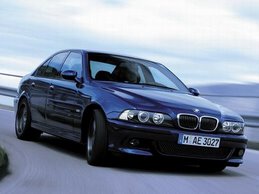
 I, however, could understand if you question my mention of the Cressida as it's a car considered to be styled in a manner resembling a stone brick. Most would tell you it's about as interesting as one too, but I'd beg to differ. Oh yes, strip away that simple exterior - which I quite like for the record - and you've got a highly involving car. Precise steering, a chuckable chassis, decent handling and a road-connected feel like few other Toyotas. And actually, in my opinion, nearly comparable to a BMW E34 5-Series of the same vintage.
 My great experience with Toyota's can attest to the 1990 Cressida being amongst the most involving and entertaining Toyota's to drive - even though you'd never know it by looking at it's plain-jane exterior. And hell, I haven’t even mentioned the various selections of Celicas…
That all being said, I do believe it's important for critics to look at Toyota's past history before being overly critical of the company's operations and philosophy. Conversely, I do realize we are not living in the 1980's and 1990's anymore and this means I must move on. Nowadays it's clear that Toyota has pretty much attempted to rid their line-up of any real fun and exciting cars - specifically those which are RWD - so that they can obviously promote the Lexus brand. And even with that particular brand there isn't a whole lot of sport to be found, quite frankly; just about everything and anything they have is focused on luxury, but one should mention their compact IS saloon. Yeah, it's not quite as exciting or intoxicating as some of their previous vehicles (from a drivers point of view in my eyes), but it still offers a more than somewhat decent and sporty ride.
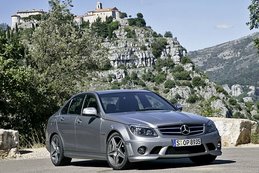
Let’s not forget about the very near future. What greater display of talent from Toyota’s fine engineers could you ask for than by displaying their arriving-soon performance flagship, the "IS-F"? With a top speed on the north side of 170 mph and 5.0 litre V8 pushing 423bhp and an insane 372lb-ft of torque you can be sure it'll be won't fail to bring a smile to its driver. Will it be as fun and entertaining as the BMW M3 and/or Mercedes-Benz C63 AMG? Maybe, maybe not - that remains to be seen, but you can count on an entertaining drive no doubt.
And lastly, but certainly not least, I am a Toyota/Lexus enthusiast who has a great deal of appreciation for all automobiles - no matter the make, no matter the type. The automotive world does not start and end with my favorite manufacturer, as it does with so many other single-make fans. For instance, and as I've made evident in the past, I am a great admirer and fan of exotics/supercars; specifically the crazier ones.
Can the words "Toyota" and "enthusiast" ever co-exist? Is such a union possible? Is it logical? Most certainly, and as I mentioned up top, you can sure there are more than a few of us out there.
By Bruce McCullochThat, folks, is what BMW calls protecting the environment; building more fuel-efficient and earth-friendly “eco” cars. Rather than sticking to the usual catch phrases of having their vehicles named such things as “LEV” (Low Emissions Vehicle), BMW deems such a name necessary to separate themselves from most every other company who practice the identical, uh, practice.
 Mind you, this is not limited to their ideals and practices on emissions, but most everything; as of late, BMW has had the great tendency to label every basic and simple technological invention with some special name; and quite frankly, it’s a marketing gimmick which is just starting to piss me off.
Now, let us take a look at the many BMW marketing names.
“Active Hybrid”:
Rather than the simple approach at calling their upcoming hybrid system a mere “Hybrid”, it just has to be an “Active Hybrid”. So then, am I supposed to believe that hybrids developed by that of Toyota and Co. are non-active?
Furthermore, BMW says the Active Hybrid version of the X6 will feature “a high-performance battery” and a “high-efficiency combustion engine”. Now quite frankly, this is bunch of doo-hickey.
“SAV”:
Sport Utility Vehicle (AKA “SUV”) used to be a hot type of vehicle, but it’s now a thing of the past and that’s why BMW chooses to label its X5 and X3 with the name of “SAV”. And thus indicates “Sport Activity Vehicle” - because it’s oh-so-good to advertise something that gives you an “active lifestyle”. Oh, please...
“SAC”:
With BMW’s upcoming sporty X6 (the concept of which was seen at Frankfurt), BMW thought neither “SUV”, nor “SAV” was appropriate. No, instead the swoopy X6 is called an “SAC”. This indicates “Sport Activity Coupe” and you know, that’s really great considering the vehicle has four doors and is a 4X4 – no matter how pointless it is as one, but then that’s just about right for all “performance” SUVs and a whole 'nother ball of wax…
“PAS”:
BMW’s next addition to their lineup – codenamed the V5 with production slated for 2009 – will wear the acronym of “PAS”. And like previous mock-ups, this has some sort of deep meaning, or at least BMW would like to believe. “PAS” stands for “Progress Activity Sedan”. Which sort of reminds me of those inscrutable, tortured Chinese-to-English translations the Chinese are putting on their home-grown cars these days, and seems faintly ridiculous on a BMW.
And I’ve saved the absolute best for last,
“LCI”
What do you call a facelift of a vehicle? Well, I, like most everyone else, call it a “facelift” as it seems logical. But of course, that’s too simplistic, so BMW calls them “LCI”; or in other words, a “Life Cycle Impulsive”.
Now excuse me, but that’s completely idiotic. We all know that neither the true enthusiast, nor the poseur, is going to purchase any of these vehicles and call them any of the aforementioned. Additionally, our current market situation has a great deal of these vehicles selling themselves, even with stiff competition – so is there really a need for such linguistic embroidery?
And while we’re on the subject of marketing tactics from BMW, I’d like to mention my displeasure with the European brochure of the M3 that I recently got the opportunity to read. In this particular brochure BMW employs a series of aggressive marketing tactics to make its competition look weak-minded. And for comparison, they’ve focused on three other entities; the Porsche 911, the Audi RS4 and the Mercedes-Benz CLK63 AMG.
In the case of the 911, BMW’s strategy is to acknowledge the 911’s greatness as a sports car, but make note of its lack of usability as a daily driver because of its tiny rear seats and small boot space. And whilst the boot space is small and the rear seats tiny, a large number of 911 owners would argue that their car can comfortably be used as a daily driver. Yes, it’s most likely not as good as a daily driver as the M3, but is there really a need to make such a dramatic attempt at downplaying the competition?
And it doesn’t tone down as they give their expert insight on both the Audi RS4 and Mercedes-Benz CLK63 AMG. Their Ingolstadt rival takes a further beating when BMW insinuates that they themselves pioneered “the high revving engine concept”, and that Audi is clearly following their path. Additionally, they’re sure to mention the M3’s significant (lower) weight advantage over the RS4 due to the Audi’s implementation of AWD – which BMW claims has an effect on the RS4’s steering, labeling this “palpable”.
As for the CLK63 AMG, well, it takes the blunt side of the shovel when BMW claims the CLK63 is nothing but a GT car with an engine which is relatively un-interesting and a transmission which suffers from “long-legged ratios”. They finish the CLK63’s description with, “but it does not have the thoroughbred genes of the sports car”. What makes that particular quote quite idiotic is that BMW themselves explained throughout the first two sentences of the CLK’s description about how a GT car should be weighted towards comfort as opposed to sport and how this perfectly caters to the company’s customers.
Truth is, there isn’t much which BMW states that is untrue – the CLK63 is a GT, the RS4 is heavier than the M3 and the 911 is a slight less practical – but I simply cannot understand why BMW takes such aggressive marketing tactics. Companies that are reduced to making their competitors look weak generally resort to this because their product is not strong enough to stand on its own merits. This is not the case with BMW – despite the goofy names for their technology and their cars, they generally make fine vehicles. And it’s not like they have to worry about sales and what-not; after all, this is a company which on average, sells 10,000 3-Series every month in North America. Perhaps I’m just a nitpicker, but I personally find this tactic a bit much.
This strategy, combined with the aforementioned, increasingly idiotic naming conventions, has made me unhappy with BMW as of late. This is a company that occupies the rarefied air at the top of the automotive industry and it is employing cheap marketing tricks and insulting their able competitors. To me, it’s all a bit unseemly and shows poor form.
 By Bruce McCullochAnyone else remember when the automotive world, specifically that which is the supercar world, was limited and controlled? By limited and controlled, I’m referring to a market where the number of supercars wasn’t reminiscent to the vast amount of fruit types you buy at the super-market.
It’s no secret that I love supercars and take great joy in discussing them, examining them and above all else, dreaming about them. After all, supercars are the acme and epitome of the automotive world; they showcase all of which has advanced in our century – speed, power, technology, handling, braking – you name it, actually.
Thing is, though, I’m starting to lose much of my faith and interest in supercars and the reason is because they are now becoming a bit garden variety, a rich man’s play palace where bragging rights are the number-one priority. Though, one could argue that’s always been the case with these unambiguously expensive automobiles, but I happen to think the market has finally shifted them into an undesirable state.
Never did I think that in my life time supercar companies would be competing for a market share which in retrospect is similar to that Toyota versus Honda – albeit at a much smaller level. The supercars market through out the 90’s was much simpler and it only consisted of a few marques; those being such greats as Ferrari, Lamborghini, Porsche and Jaguar. It was all so simple back then, but now we don’t have just four marquees, we over have twenty and probably some more on the way as I type this – all jostling for their place and of course, while trying to out-do each other.
Sure, it always about competing, but not at such a level as it is now. And it would appear that the turn of the decade was the birth of these many new manufacturers and the “new” way of selling, producing and manufacturing these automobiles. No longer is it a simple and mostly innocent game of billiards among guys that know each other down at the gentlemen’s club, (where you also debate important things like Jessica Alba or Rosario Dawson, steak or lobster, etc. ), it’s an all-out war where the specialty maker that produces the most powerful car is ultimately the winner.
Production, Performance & Power:
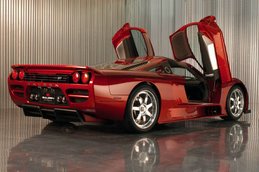
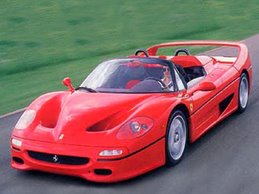
With the exception of F40, exotic production through out the 1990’s was pretty low-key. Just 300 Jaguar XJ220’s were built, just 349 Ferrari F50’s were manufactured; and on a smaller scale of exotica, just 60+ some McLaren F1’s were built. Furthermore, each of these high-end models didn’t have a dozen multiple variations.
Thus is the main reason why my interest in supercars is swiftly fading. As these companies are now engrossed in making big money and keeping up with the competition, one variation with a 5-year life span is deemed no longer sufficient from a business point of view. Now, if you plan to have a 5-year life span for a model it’s going to need multiple updates; everything from a new sticker on the boot to a possible 200 horsepower upgrade.
Look at the recent crop of Aston Martin’s for instance. Firstly, they had the 6-speed sequential DB9 coupe, then a 6-Speed Sequential cabriolet, then a 6-speed coupe and then 6-speed cabriolet, then a sports package, and then an 06 model update featuring everything that sports pkg had and now, the DBS and the DB9 LM. Even the V8 Vantage has undergone a similar twist of marketing with potential owners being force-fed multiple variations; each one promising something new and unique. Even such companies as Lamborghini and Bugatti have followed this trend; evidenced by both launching special editions of their flagship at the Frankfurt Autoshow.
And let us have a look at the power upgrades these vehicles are constantly undergoing. The first generation Koenigsegg CC8S had 655bhp – more then enough for any sane individual – but 600+ bhp was becoming a casual figure (even amongst various Mercedes-Benz automobiles), and as a result the company decided to step it up and give it a full 806bhp. That is merely one example, but one that is evidently at the top of the peak; other such manufacturers are following by pumping up model updates with an additional 100 some horsepower.
And so forth and so forth, company and after company following these trends. Now, I am fully aware that from a business standpoint such an approach is doing these manufacturers mighty, so why then, am I complaining?
Guess I’m just an ‘ol car romantic; I loved the day when the market was exclusive and unique. It was smaller, and therefore more mentally manageable, and frankly, more emotionally intimate regarding the wonderful machines themselves.
Guess I should get used to the Camry vs. Accord market of the supercar, eh?
By Bruce McCulloch
FRANKFURT: You may recall that just a few days ago I wrote a short piece on Wiesmann’s up and coming “MF5” flagship supercar. At the time at which that was written little was known about how much the vehicle would differ from its counterpart, but the time of pondering has come to an end as Wiesmann has now released the final details of the vehicle.
So then, what shall we start with? Well, how about the “revealing” of the new car. Many, including myself, had assumed that Wiesmann was to release the MF5 at the Frankfurt Autoshow, but that turned out to be untrue. Rather than renting out a spot at Germany’s most prestige Autoshow, Wiesmann deemed it more than appropriate to rent out the bottom half of the Frankfurt’s “lighttower” on the main street of the German city. A private, more organized showing; yes, but certainly not a coincidence that they decided to reveal it in the town of Frankfurt during Autoshow week. So, PR tricks and all, let us get to the actual vehicle:
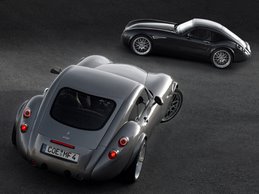
 If wanting to turn heads is your thing, the new MF5 will not fail to deliver as it looks like nothing else. It’s blunt, angry, aggressive and above all else, racy. There’s little doubt in my mind that Wiesmann’s goal was to make the MF5 visually as close as possible to their successful GT race car. And I had suspected upon first glance of the vehicle that it had notably grown in size over its counterpart and indeed, it has; the MF5 is 5 cm lower, 9.6 cm wider, 8 cm longer and lastly, features modifications in width to both the front and rear track.
 The changes are evident too; deeper front facia, various air-vents amongst the body and a rear end that looks like something out of a cartoon. Notable are the spoiler – made from nothing other than carbon fibre – and a redesigned undertray diffuser intended to help the MF5 keep it controlled at the amazing speeds which it’s able to achieve. And trust me, you’ll need it.
You’ll need it because as I’ve mentioned before, this car has the same 10-cylinder motor from the BMW M5 and M6. In short, that means a 12.1 compression ratio, 507bhp, 384lb-ft of torque (or 520 Newton Metres) and a wonderful redline of 8,250 rpm.
I had previously speculated on what transmission the MF5 would be using; perhaps thinking Wiesmann would offer both a manual and a sequential transmission for the vehicle – as they had done with previous vehicles. However, it would turn out that the MF5 is only available with BMW’s 7-speed sequential SMG transmission. Still, having SMG to play with in a 507bhp supercar can hardly be a vice…
 One big and obvious push with the MF5’s release is Wiesmann’s business philosophy in making sure it’s road-worthy and more importantly, safe. Thus is why this vehicle boasts a whole level of features not available on previous models: “Dynamic Stability Control” (DSC), “integrated side-collision protection”, “3 point seat belts” and a whole host of other features likely to keep you alive, if not unscathed, should you slide off the road. And to back it up, all of these systems have been developed by the great conglomerate that is BMW. Not unique to Wiesmann, the specialty car manufacturer, some one-off fans might query? True, but tried and tested by one of the foremost car companies in the world, with superb engineering resources at their disposal, so you know it will work when it needs to, and that’s fine with me.
As for the interior, well, modifications are mostly vacant, but that still hasn’t stopped the small manufacturer from further improving upon the vehicle. Notably, the MF5 comes standard with driver and passenger airbags – something never available on any previous Wiesmann – as well as redesigned bucket seats with supposed “excellent lateral support”. Also worth mentioning is that these seats are made to order, and designed to fit each and every customer. Should that not be enough incentive to purchase one of these, you’ll be glad to learn that one can order special seats made from carbon fibre basing - which are of course lighter.
Suffice to say, the addition of the large 10-cylinder motor and various safety components, the MF5 has gained some 140kg over its counterparts; 1240 vs 1380kg, MF4 vs MF5 respectively. Nevertheless, 100 km/h (62 mph) is promised to take just 3.9 seconds.
So there you have it – should you have the desire; and above all else, the money to purchase something rare (just 25 are expected), powerful, fast and wacky, this is a great choice. Production is set to start in the spring time of 2008, but be prepared, starting prices commence at a base of 178,900€, and, of course, go up.
 It’s not often that you hear the words “awful” and “supercar” in the same sentence. Actually, finding the word “awful” to describe a “supercar” is about as rare as finding someone who actually likes the repugnance of a Pontiac Aztek.